Introduction
A private business operating platform for growing companies, plus how core, modules and railbase.app fit together.
Updated
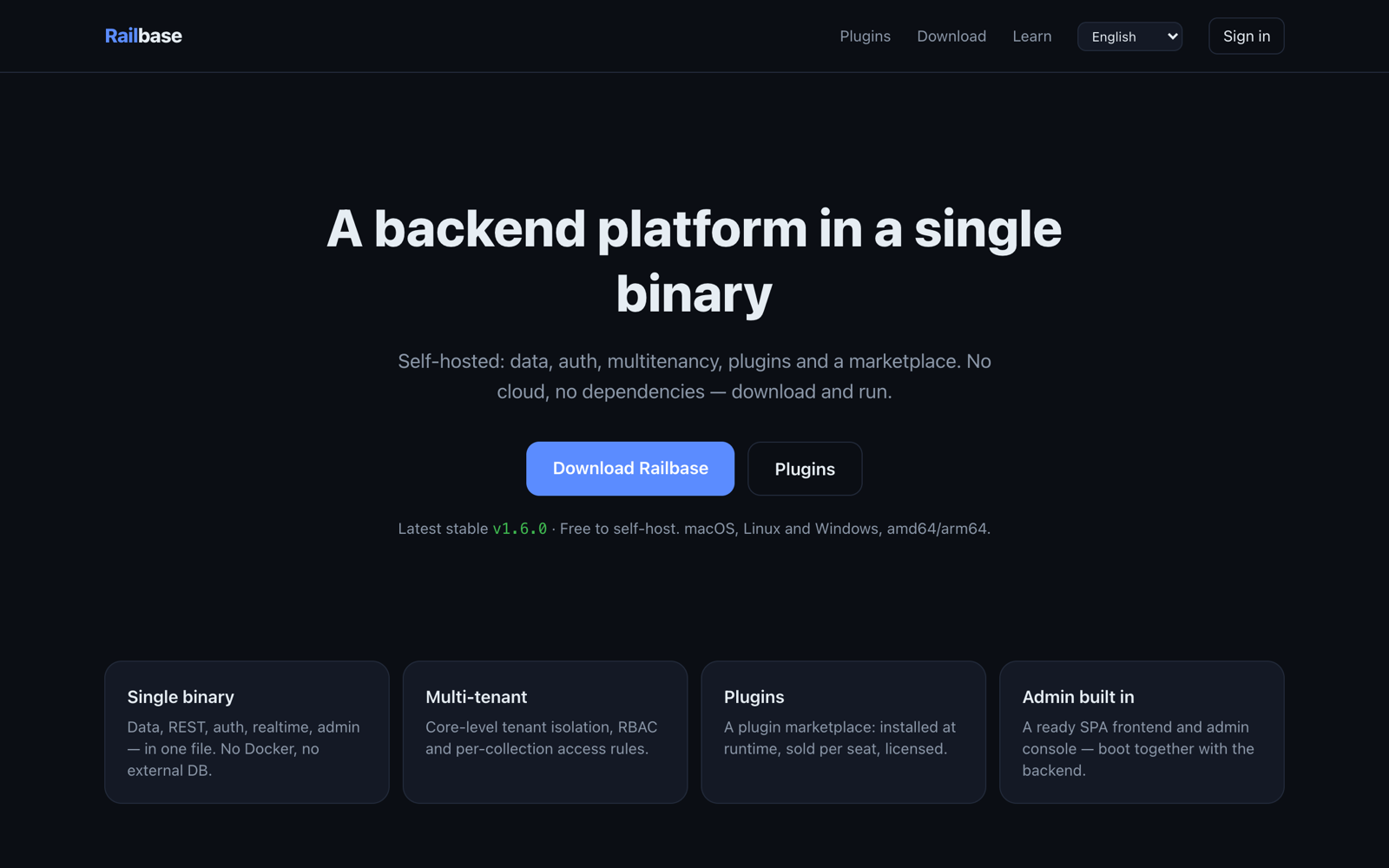
Railbase is a self-hosted business operating platform for growing companies. It gives a small or medium enterprise one private system for its business data, users, approvals, documents, workflows and modular business apps — more structured than spreadsheets, more integrated than SaaS sprawl, and lighter than an ERP rollout.
Under the hood it is a single Go binary you self-host: a production-grade runtime with auth, a typed data layer (Vault, a single-file NoSQL document store), REST + realtime APIs, multi-tenancy with RBAC, jobs and an admin console — out of one executable with no external database to operate.
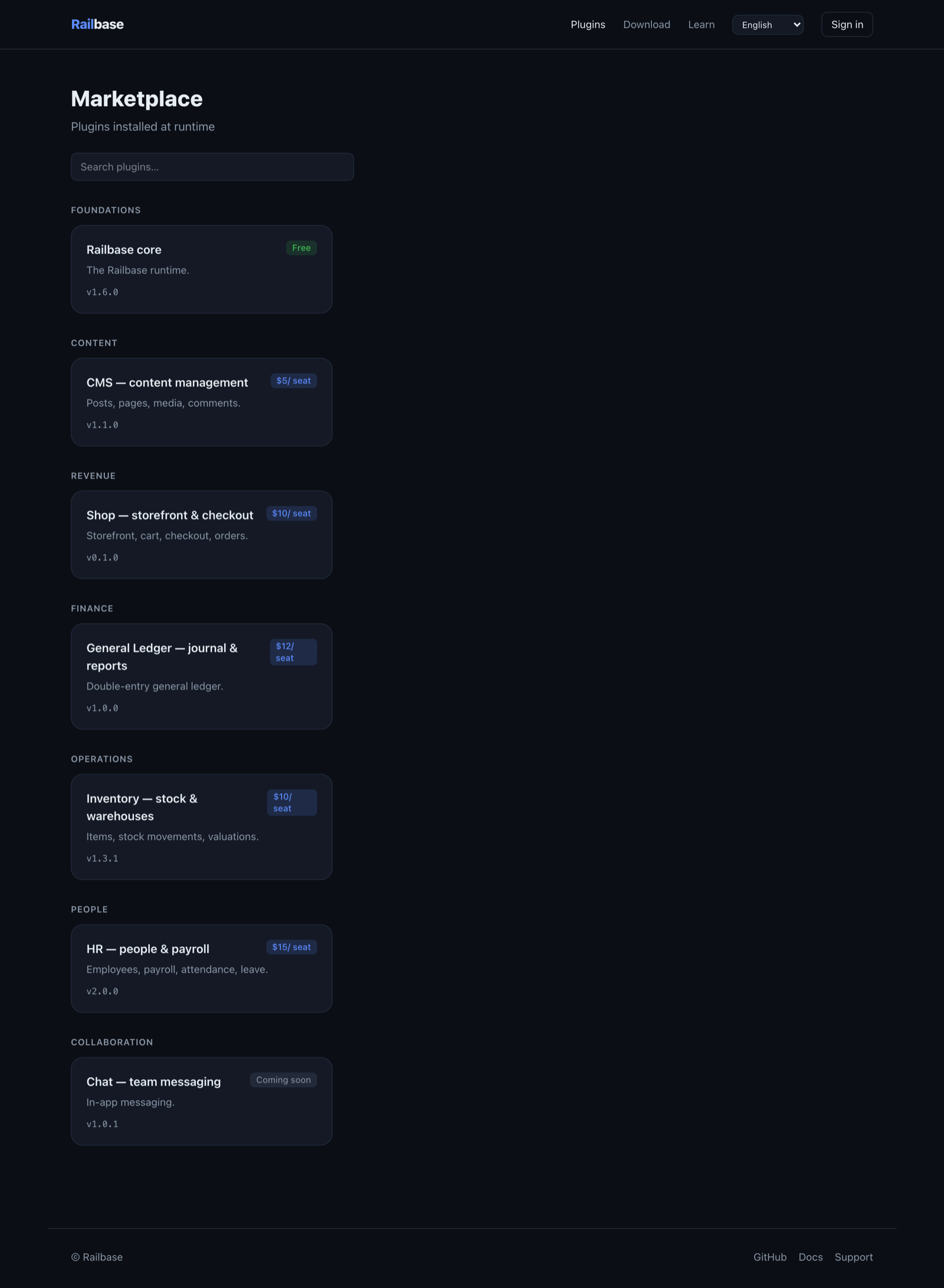
The core is free to download and run — it is the adoption and trust anchor. Business capabilities are delivered as modules: some are built into the free core, some are public beta, and others are pilot or coming soon. The marketplace catalog is the source of truth for what can be installed today. Paid modules are subscriptions you buy and install at runtime from a marketplace built into the admin. There is no rebuild and no third-party binary to vet; the core pulls a signed, licensed bundle and runs it.
The three pieces
| Piece | What it is | Who runs it |
|---|---|---|
| Railbase core | The free single binary you download and host | You |
| Business modules (plugins) | Paid, signed add-ons installed at runtime | You (bought via the marketplace) |
| railbase.app | The vendor's licensing, distribution & billing server | The vendor (this site) |
You run the core. railbase.app is the source of truth for the catalog, prices, your licenses, and payments — your instance syncs with it to discover plugins, complete purchases, fetch signed artifacts, and keep licenses fresh. You never download a plugin file by hand, and your server never stores card data.
Note
railbase.app is a secondary resource for day-to-day work. The same catalog, billing, trials, and install actions for available modules are reachable from inside your own Railbase admin. See Installing plugins.
What you'll find in these docs
- Quickstart — download, run, create an admin, and open the marketplace in a few minutes.
- Core Concepts — the architecture, how plugins work, and licensing & seats.
- Guides — day-to-day tasks like installing plugins and managing billing.
- Self-Hosting — deploying, backups, and security for production.
- Reference — the CLI and environment variables.
What Railbase is not
Important
In the hosted distribution model, commercial plugins are acquired only through the built-in marketplace as signed, verified artifacts — there is no "sideload an untrusted binary from disk" path. Internal development and embedder hooks exist for building plugins with the core, but they are not a customer distribution channel. See How plugins work and Installing plugins.